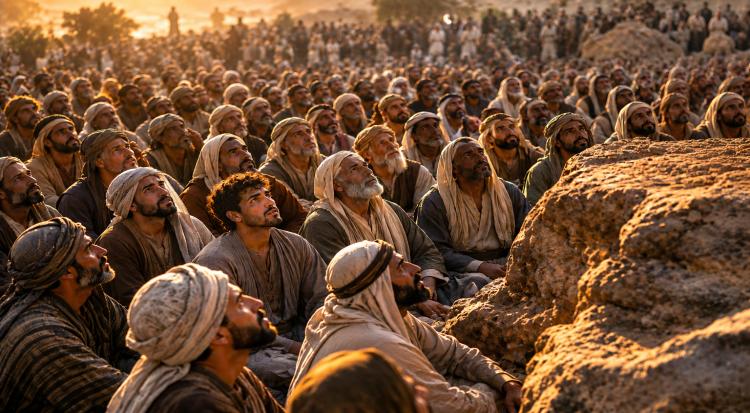
The Farewell Sermon, also known as Khutbat al-Wada’, was delivered by Prophet Muhammad ﷺ during his final Hajj pilgrimage on the 9th of Dhul Hijjah, 10 AH, corresponding to March 632 CE, near Mount Arafat in Makkah, Saudi Arabia. Islamic historians describe it as one of the most important speeches in Islamic history because it summarised key principles of faith, justice and social conduct shortly before the Prophet (saws) death.
Scholars note that no single narration preserves the sermon word-for-word in full. Instead, its contents are gathered from several authentic hadith collections and early Islamic historical sources, including Sahih al-Bukhari, Sahih Muslim and early seerah literature. While wording differs slightly between narrations, the central themes remain consistent across sources.
The Farewell Sermon (English Compilation)
Below is a commonly accepted English compilation drawn from multiple narrations and historical sources:
O People, lend me an attentive ear, for I know not whether after this year I shall ever be amongst you again. Therefore, listen carefully to what I am saying and take these words to those who could not be present here today.
O People, just as you regard this month, this day, and this city as sacred, so regard the life and property of every Muslim as a sacred trust. Return the goods entrusted to you to their rightful owners. Hurt no one so that no one may hurt you. Remember that you will indeed meet your Lord, and that He will indeed reckon your deeds.
Allah has forbidden you to take usury; therefore all interest obligations shall henceforth be waived. Your capital is yours to keep. You will neither inflict nor suffer inequity.
O People, it is true that you have certain rights over your women, but they also have rights over you. Remember that you have taken them as your wives only under Allah's trust and with His permission. Treat your women well and be kind to them, for they are your partners and committed helpers. And it is your right that they do not make friends with anyone of whom you do not approve.
O People, listen to me in earnest. Worship Allah, perform your five daily prayers, fast during the month of Ramadan, give your Zakat, and perform Hajj if you can afford to do so. All mankind is from Adam and Eve. An Arab has no superiority over a non-Arab, nor does a non-Arab have superiority over an Arab. A White person has no superiority over a Black person, nor does a Black person have superiority over a White person — except by piety and good action.
Know that every Muslim is a brother to every Muslim, and that the Muslims constitute one brotherhood. Nothing shall be legitimate to a Muslim that belongs to a fellow Muslim unless it was given freely and willingly. Do not therefore do injustice to yourselves. Beware of Satan for the safety of your religion. He has lost all hope of leading you astray in major matters, so beware of following him in minor matters.
I leave behind me two things — the Quran and my Sunnah — and if you follow these, you will never go astray. O People, no prophet or messenger will come after me, and no new faith will emerge. All those who listen to me shall pass on my words to others, and those to others again, and it may be that the last ones understand my words better than those who listen to me directly.
He then said - Have I conveyed the message?
The people answered: “Yes.”
He Said - O Allah, bear witness that I have conveyed Your message to Your people.
Key Lessons Derived From the Sermon
Sanctity of Human Life
The sermon strongly emphasised the protection of life, wealth and honour. Islamic scholars often point to this as one of the clearest declarations against injustice and oppression.
Equality of Humanity
One of the sermon’s most quoted teachings is the rejection of racial superiority. Historians and Muslim scholars describe this statement as a major moral principle within Islam.
Women’s Rights and Responsibilities
The Prophet ﷺ instructed Muslims to treat women with kindness and fairness while also outlining mutual rights and responsibilities within marriage.
Ending Tribal Revenge and Exploitation
The sermon abolished pre-Islamic blood feuds and usury practices that were common in Arabia at the time, aiming to establish a more just society.
Holding Firm to Islamic Guidance
The Prophet ﷺ reminded Muslims to remain attached to the Qur’an and his teachings after his death.
Historical Importance
The Farewell Sermon is widely regarded by Muslims as the Prophet Muhammad’s ﷺ final public address. Many Islamic scholars also connect the occasion with the revelation of Qur’an verse 5:3:
“Today I have perfected for you your religion…”
The verse is believed to have been revealed during the Farewell Pilgrimage. While historical estimates vary slightly, the sermon is widely believed to have been delivered before more than 100,000 followers.