Why Is Latin America Moving Closer to Israel?
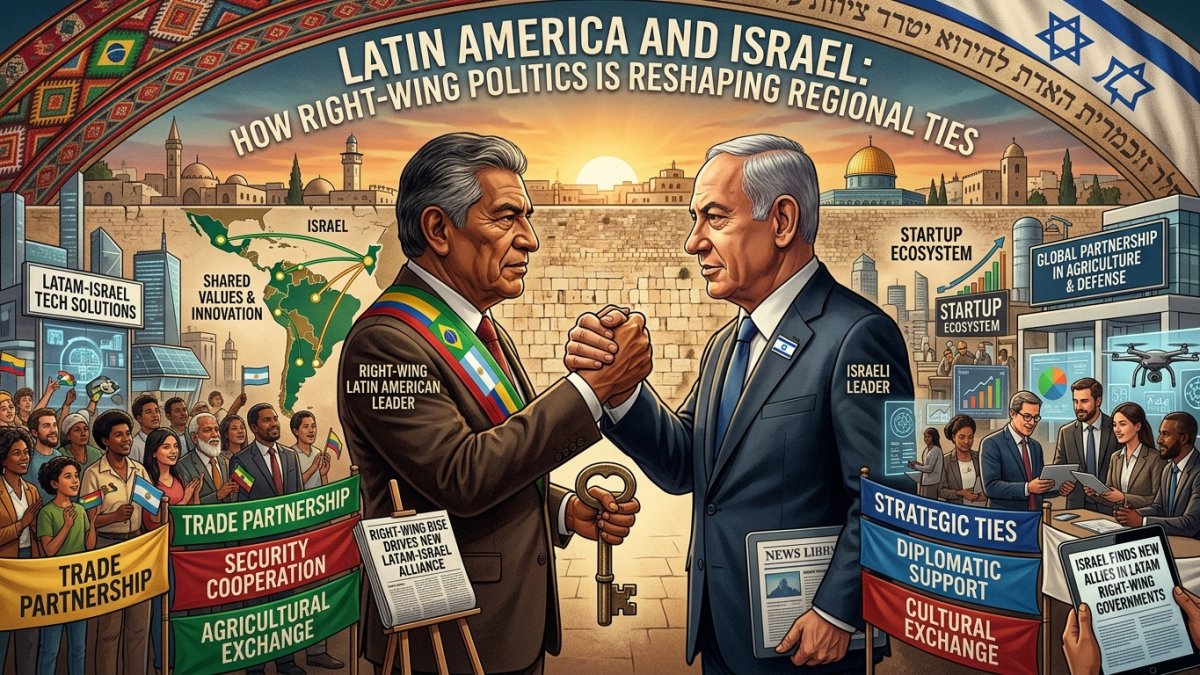
Latin America is experiencing a growing political divide over Israel and Palestine. While public opinion in many countries has increasingly turned against Israel’s actions in Gaza, a number of governments are moving in the opposite direction.
The shift has been particularly visible among newer right-wing governments. Countries including Argentina, El Salvador, Ecuador, Chile, Peru, Bolivia, Honduras, Costa Rica and Colombia have strengthened or signalled closer diplomatic, security and technological ties with Israel.
Colombia provides a significant example. President-elect Abelardo de la Espriella has indicated that his government will restore relations with Israel, suspend plans for a Palestinian embassy and potentially move Colombia’s diplomatic mission to Jerusalem. His election marked a major change from outgoing President Gustavo Petro, who had taken a strongly pro-Palestinian position.
Petro had also accused an Israeli cyber-intelligence company of using large numbers of automated accounts to spread disinformation during Colombia’s election campaign. The allegation remains contested, but Israeli Prime Minister Benjamin Netanyahu openly welcomed De la Espriella’s victory.
Bolivia has also reversed course. After breaking diplomatic relations with Israel following the October 2023 attacks, the country restored ties under its new centre-right government.
Security and technology
The relationship between Israel and Latin America extends beyond diplomacy. Israeli surveillance technology, weapons and security expertise have become important tools for governments across the region.
The use of Israeli spyware such as Pegasus has attracted controversy after journalists and opposition figures were reportedly targeted in several countries. Israeli weapons and security technology have also been used by police forces, including in Brazil.
Critics argue that these relationships allow governments to strengthen surveillance and security capabilities without sufficient public scrutiny.
The growing ties also reflect broader political changes. Governments seeking closer relations with Washington and adopting more conservative or right-wing policies have often shown greater willingness to cooperate with Israel.
Brazil could be decisive
Brazil’s upcoming presidential election could become an important test of this political shift.
Flávio Bolsonaro, the son of former President Jair Bolsonaro, has received support from Israeli Prime Minister Benjamin Netanyahu and Argentine President Javier Milei, one of Israel’s strongest supporters in the region.
Milei has described himself as a “fanatic of Israel” and has backed plans to move Argentina’s embassy to Jerusalem.
President Luiz Inácio Lula da Silva, meanwhile, remains one of the region’s most prominent critics of Israel’s Gaza campaign and has repeatedly described it as genocide.
The outcome of Brazil’s election could therefore either reinforce Latin America’s growing alignment with Israel or strengthen the region’s traditional support for Palestinian rights.
At the heart of the debate is a widening gap between public opinion and government policy. While many Latin Americans continue to identify with the Palestinian cause, political leaders are increasingly balancing those sentiments against strategic relationships involving Washington, Israel, security cooperation and economic interests.