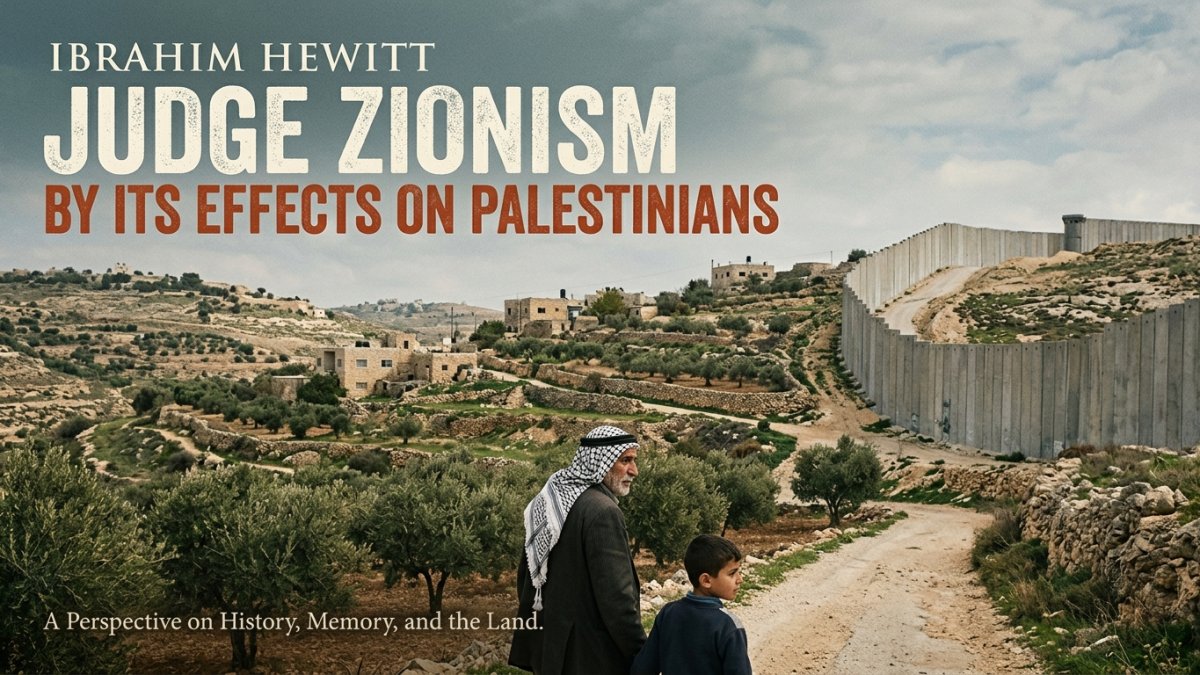
Writer Ibrahim Hewitt argues in an opinion article that debates over Zionism should examine the policies carried out in its name and their effects on Palestinians. He draws on a visit to occupied Palestine in 1988, during the first intifada, and connects his account of that trip to current disputes over Israeli law, occupation and the war in Gaza.
Revisiting a 1988 visit
Hewitt recalls travelling with a British Muslim delegation and describes what members said they saw during visits to Palestinian communities and a hospital. He says the experience shaped a booklet written soon afterwards and his longstanding view that the treatment of Palestinians should be judged through their lived conditions, not only political arguments about terminology.
The author also acknowledges a mistake in the delegation’s earlier language, which referred broadly to “the Jews” when discussing Israeli policies. He says this wrongly blurred the difference between Jewish people and Zionism. Jews hold diverse political views, and Zionists are not all Jewish. Criticism of a state, government or political movement should not be treated as hostility toward Jews as a people.
Law, identity and Palestinian rights
Hewitt points to Israel’s Law of Return, which gives Jews a right to immigrate to Israel, and the 2018 Nation-State Basic Law, which says the right to exercise national self-determination in Israel is unique to the Jewish people. He argues that these laws show how the state defines belonging and political rights. The legal provisions are matters of public record; the conclusion that they constitute discrimination is Hewitt’s interpretation.
The essay also links the displacement of Palestinians in 1948, the continuing occupation and the destruction in Gaza to what Hewitt describes as the consequences of Zionism. He uses the term “genocide” to characterise Israel’s war in Gaza. That is a contested legal and political allegation: Israel rejects it and says its military campaign is directed at armed groups and is an act of self-defence.
Where criticism ends and prejudice begins
Hewitt argues that criticism of Zionism or Israeli policy should not automatically be labelled antisemitic, while acknowledging that antisemitism is real and must be opposed. His point is that criticism should address specific laws, actions and consequences without assigning collective blame to Jewish people.
This is an opinion piece, not a neutral account of Zionism or a legal ruling on genocide. The author’s argument is that political ideologies should be assessed through the institutions and policies associated with them, while maintaining a clear distinction between political criticism and prejudice against a religious or ethnic group.