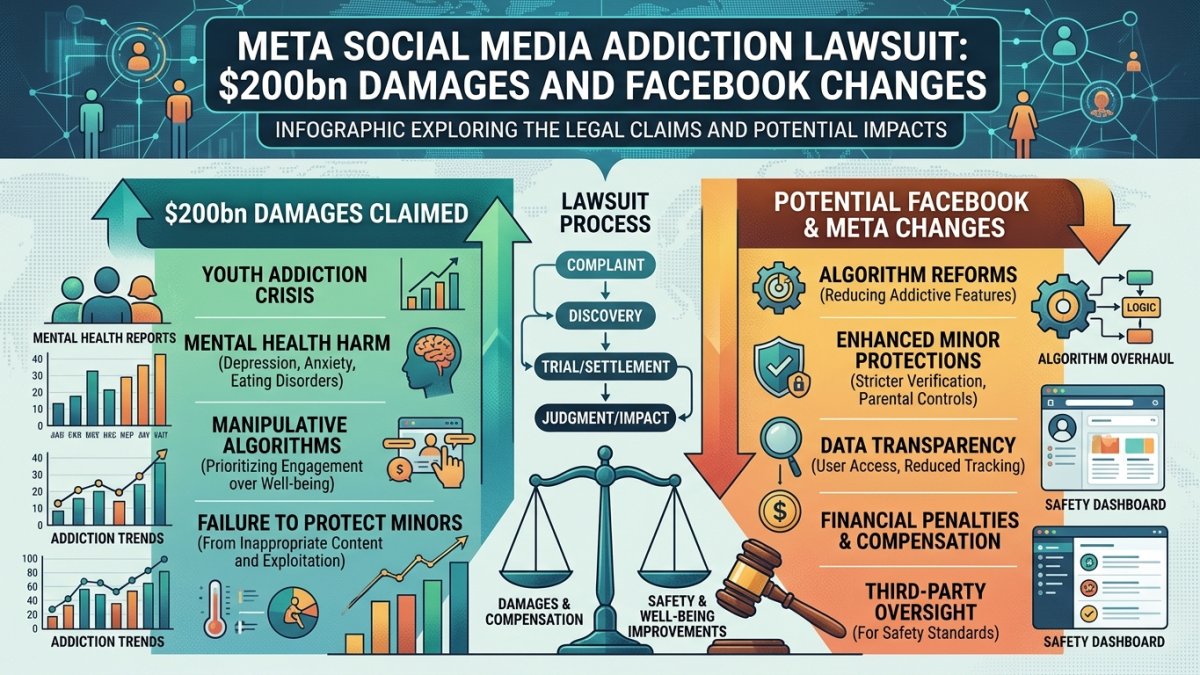
Meta Faces Landmark Lawsuit Over Social Media Addiction and Billions in Potential Penalties
Meta is facing a major US federal trial that could force fundamental changes to Facebook and Instagram and expose the company to potentially enormous financial penalties.
The case was brought by attorneys general from 29 US states, who accuse Meta of deliberately designing its platforms to keep young users engaged through features such as infinite scrolling. They also allege that the company knew its platforms could encourage addictive behaviour and improperly collected data on minors.
The six-week trial could have far-reaching consequences. Meta has said potential state penalties could reach as much as $1.4 trillion, although the coalition of states is seeking about $200 billion in damages.
That figure would be roughly equivalent to Meta's entire 2025 revenue, which was nearly $201 billion. The company reported $83.2 billion in operating income that year.
The case adds to Meta's growing legal and financial pressures. In separate lawsuits, the company has already faced hundreds of millions of dollars in penalties. Meanwhile, its Reality Labs division has lost around $70 billion since 2020, while Meta is spending heavily to expand its artificial intelligence infrastructure.
Meta's cash flow also fell sharply from $12 billion in the first quarter to $784 million in the second quarter, adding to concerns over the company's spending and investments.
Potential impact on Facebook and Instagram
The biggest threat may not be the financial penalties but demands to change how Meta's core platforms operate.
The states are seeking changes to features and business practices that encourage prolonged engagement, including infinite scrolling. Such changes could directly affect Meta's advertising model because the company makes money from the number of advertisements and other content impressions users see.
The longer users remain on Facebook and Instagram, the more advertising impressions Meta can generate. Restrictions on engagement-driven features could therefore put pressure on its highly profitable advertising business.
Meta denies the allegations and has warned investors that defending its numerous lawsuits is costly and can place a significant burden on the company's management and employees.
Analysts say the outcome could become an important test of how governments regulate the design of major social media platforms, particularly when children and teenagers are involved.