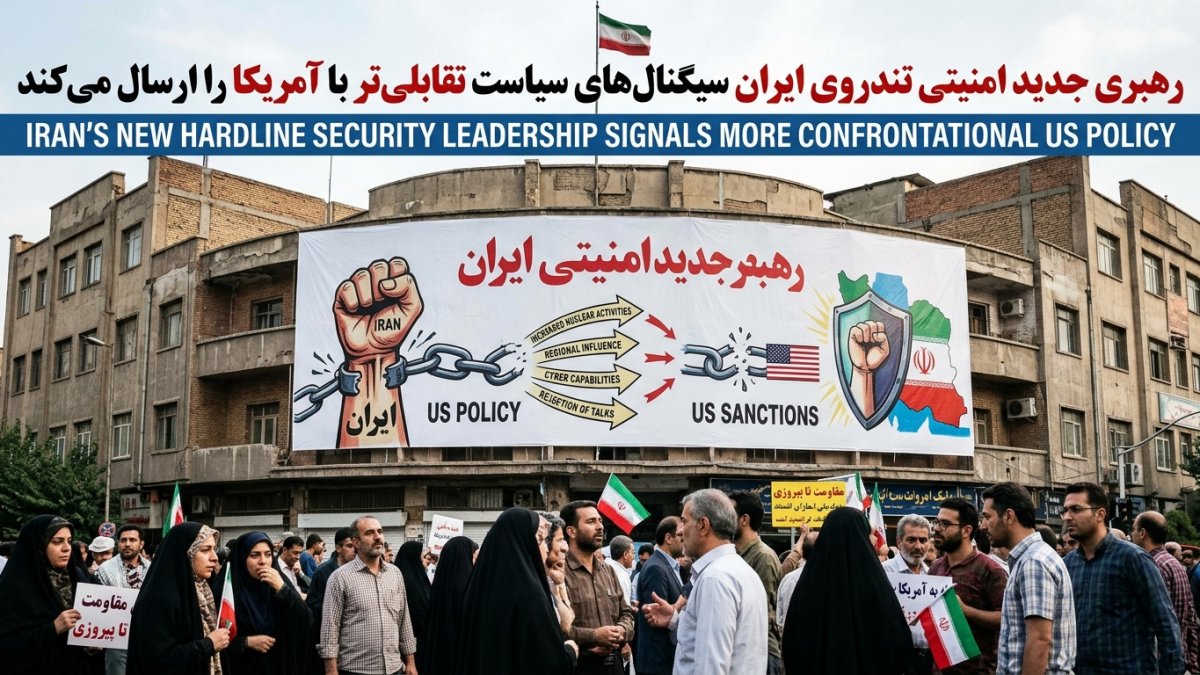
Iran’s New Hardline Security Leadership Signals a More Confrontational Approach
Iran’s Supreme Leader Mojtaba Khamenei has reshuffled the country’s top security leadership, appointing several veteran figures from the Islamic Revolutionary Guard Corps (IRGC) as Tehran prepares for what officials appear to expect will be a prolonged confrontation with the United States.
The appointments, made on August 9 and 10, filled key positions left vacant after senior officials were killed during recent conflicts. Analysts say the move strengthens the influence of the IRGC’s old guard and signals a more hardline security posture.
Jason Brodsky of United Against Nuclear Iran said the appointments suggest Tehran is preparing to remain on a wartime footing for the foreseeable future and adopting a more “risk-ready, confrontational stance”.
The reshuffle could also affect Iran’s diplomatic engagement with Washington, particularly after the expiry of a 60-day deadline for reaching an agreement.
Mohsen Rezaei
Mohsen Rezaei, 71, a former IRGC commander during much of the Iran-Iraq war, has been appointed secretary of Iran’s Supreme National Security Council.
Rezaei has repeatedly issued tough warnings against the United States. He previously threatened that Iran would sink American ships in the Strait of Hormuz if Washington attempted to police the strategic waterway and warned that US attacks would trigger a major missile response.
The United States sanctioned Rezaei in 2020 over alleged involvement in the 1994 bombing of a Jewish community centre in Argentina.
Hossein Taeb
Hossein Taeb, a cleric and former IRGC intelligence chief, has been appointed commander of the Basij, the Guards’ large paramilitary organisation.
Taeb led IRGC intelligence for nearly 15 years before being abruptly removed in 2022. His return to a senior security position is seen as particularly significant because of his reported closeness to Mojtaba Khamenei.
Analysts believe Taeb could play a major role in suppressing renewed domestic unrest as Iran faces worsening economic conditions and the possibility of another wave of protests.
Ahmad Vahidi
Former interior and defence minister Ahmad Vahidi has become commander-in-chief of the IRGC, making him the third person to hold the position in less than a year.
His predecessors, Mohammad Pakpour and Hossein Salami, were killed during recent wars involving Iran.
Vahidi maintained a relatively low profile during the conflict but was later publicly confirmed as IRGC commander by Mojtaba Khamenei. The US previously sanctioned him over alleged responsibility for serious human rights abuses.
Ali Abdollahi
Ali Abdollahi has been appointed chief of the General Staff of Iran’s Armed Forces, giving him responsibility for coordinating between the regular military and the IRGC.
A former commander of the Khatam al-Anbiya central military headquarters, Abdollahi has also issued warnings that any renewed US attack would receive a harsher Iranian response and could expand the conflict across the region.
Taken together, the appointments point to a security leadership dominated by experienced IRGC figures and a government preparing for prolonged confrontation abroad while seeking tighter control at home.