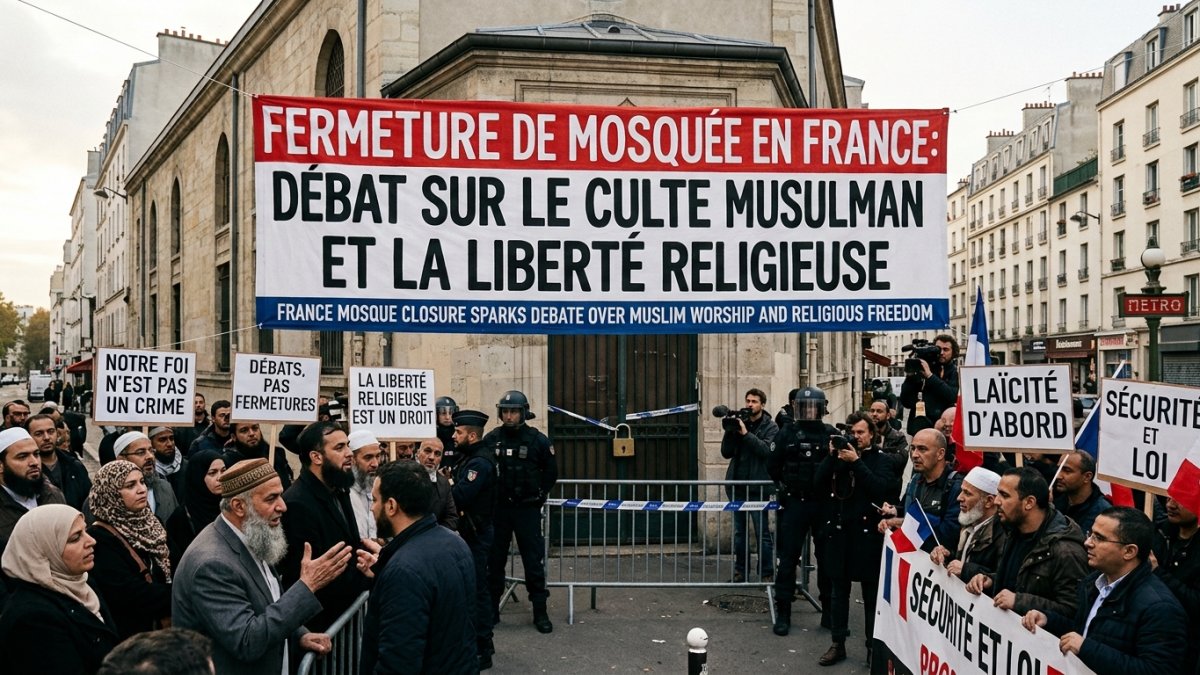
France’s Mosque Closures Fuel Fears of Growing State Control Over Muslim Worship
A recent French court decision upholding the six-month closure of the Attaqwa Mosque in Aulnay-sous-Bois has renewed concerns among Muslim organisations and lawyers over growing state intervention in Islamic worship.
The Montreuil Administrative Court rejected a challenge to the closure order, which accused sermons and social media statements linked to the mosque of encouraging violence, hatred and terrorism. Authorities also cited the presence of people considered radicalised.
The mosque’s supporters argue that the decision threatens religious freedom. They are particularly concerned that authorities relied partly on Quranic verses and references to widely recognised Islamic works, including writings by the 13th-century scholar Imam al-Nawawi.
Lawyers representing the mosque say this risks treating religious texts themselves as evidence of extremism. They also question why some of the statements cited by authorities date back several years.
The court, however, ruled that the closure did not unlawfully interfere with freedom of worship or France’s principle of secularism, saying the prefecture had relied on additional material beyond religious texts.
Wider debate over mosque closures
The case comes amid a broader expansion of French government powers over Muslim institutions. The 2021 anti-separatism law strengthened prefectural authority over religious associations and places of worship and expanded the grounds on which mosques can be closed.
Critics say the policy has contributed to an increasingly interventionist approach to Islam. Researcher Franck Fregosi has described the trend as an “authoritarian shift in French secularism”, arguing that authorities are increasingly involved in the internal governance of mosques, including the supervision of imams and worshippers.
Muslim representatives also complain that mosques can face closure or restrictions for technical and administrative reasons, including planning, safety and accessibility regulations.
Official Interior Ministry figures say 12 places of worship have been administratively closed since 2017 for reasons related to radicalisation, most of them mosques. Other investigations suggest the number of Muslim places of worship affected by broader administrative inspections and regulatory closures is considerably higher.
The government has also sought greater control over the appointment and training of imams, officially arguing that the measures are intended to reduce foreign influence and prevent radicalisation.
Critics fear that political issues discussed in mosques, particularly Palestine and Israel’s war in Gaza, can also become grounds for accusations of extremism or terrorism-related offences.
A planned expansion of state oversight could further increase prefectural powers to close places of worship, although proposed legislation on the issue has not yet become law.
For Muslim communities in France, the Attaqwa case has therefore become part of a larger debate over where the line should be drawn between preventing incitement to violence and allowing Muslims to freely practise and discuss their faith.