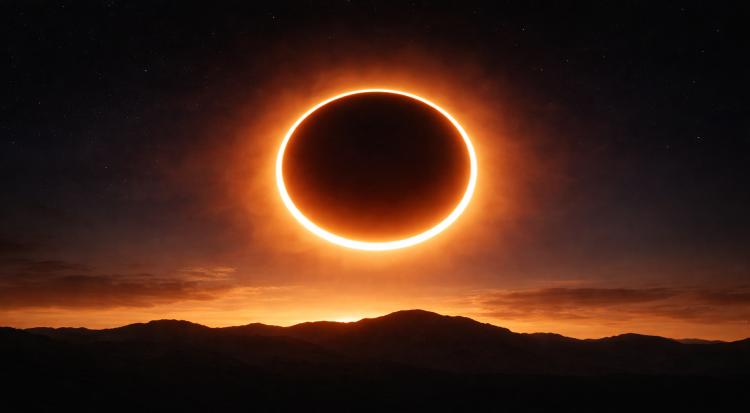
A rare annular solar eclipse, often referred to as a “Ring of Fire,” was visible on February 17, 2026, offering skywatchers a striking celestial display across parts of the Southern Hemisphere.
The eclipse reached annularity — when the Moon passes directly in front of the Sun but appears slightly smaller, leaving a bright ring of sunlight visible — over portions of Antarctica. Partial phases of the eclipse were visible in parts of southern Africa and South America, depending on local weather conditions.
Unlike a total solar eclipse, an annular eclipse does not completely block the Sun, as the Moon is too far from Earth in its orbit to fully cover the solar disk. Astronomers noted that proper eye protection was required throughout the event, as looking directly at the Sun without certified eclipse glasses can cause serious eye damage. The February eclipse was one of the most notable astronomical events of the year, drawing attention from scientists and amateur observers alike.