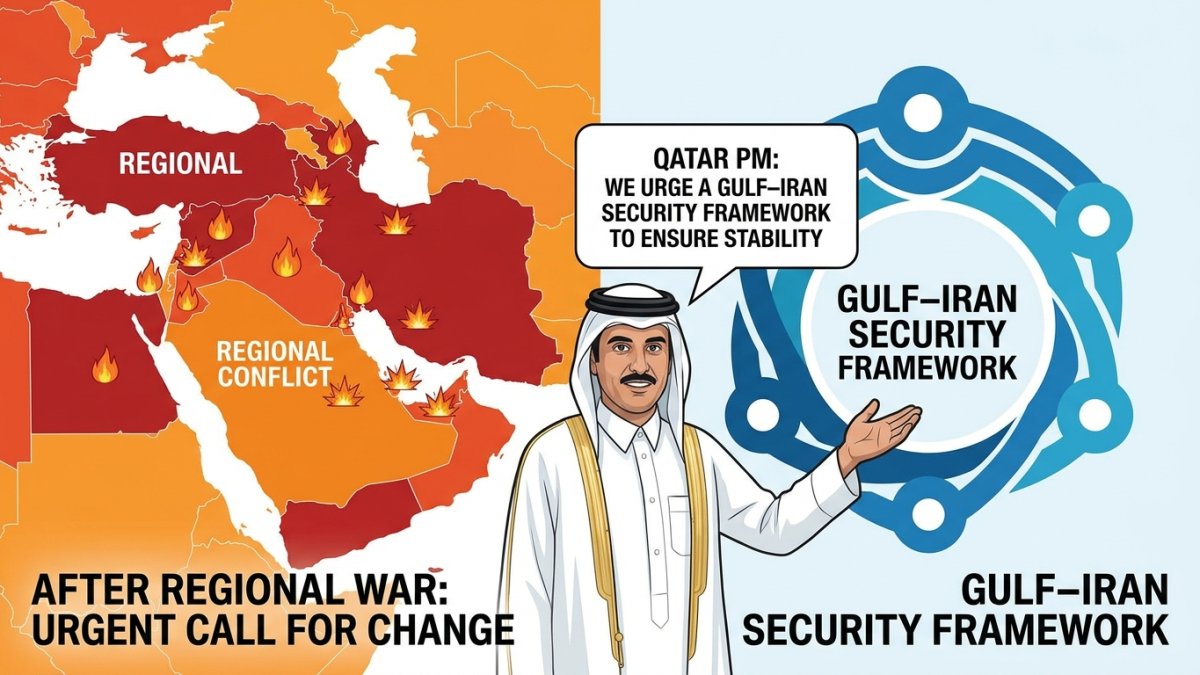
Qatar’s Prime Minister and Foreign Minister, Sheikh Mohammed bin Abdulrahman Al Thani, has urged Gulf states and Iran to establish a regional security framework. Speaking at the Qatar Economic Forum in New York alongside the 81st session of the United Nations General Assembly, he said countries in the region should work responsibly with their neighbour Iran.
Al Thani argued that relations could not simply return to their pre-war state without an understanding that prevents any party from threatening another. He described the conflict as a moment for governments across the region to reconsider how they manage security and relations with one another.
War and ceasefire background
The United States and Israel began strikes on Iran on 28 February, saying they were targeting its government and nuclear and ballistic missile programmes. Iran then launched strikes against Israel, US bases in the region, and military and civilian locations in Arab countries that host US forces.
A conditional ceasefire was announced on 8 April. In June, Iran and the United States signed a memorandum of understanding brokered by Pakistan and Qatar. Its implementation has since stalled amid disagreements involving navigation through the Strait of Hormuz.
Qatar’s energy concerns
The conflict also affected Qatar’s energy sector. The Ras Laffan complex, the world’s largest liquefied natural gas facility, was shut in the first week of the war following an Iranian attack. The source report says two of its production trains are expected to take years to restore. Qatar also extended force majeure on LNG shipments into early November because the Strait of Hormuz blockade continued.
At the same forum, Qatar’s Energy Minister Saad al-Kaabi rejected the suggestion that new pipeline investment could make the Strait of Hormuz irrelevant within two years. He said Qatar had decided against building pipelines and would continue to rely on the strait.
Calls for Gulf diplomacy
Al Thani’s proposal comes amid wider calls for a regional political settlement. Anwar Gargash, diplomatic adviser to the UAE president, said the region needed a new approach and that any negotiations to end the war should include an Iranian-Arab dimension.
Qatar has pursued contacts with Tehran in recent months. Al Thani visited Iran for the first time since the war began and said Doha did not want ordinary Iranians to bear hardship while neighbouring countries looked on. Qatar’s defence minister has also held security talks with his Iranian counterpart.