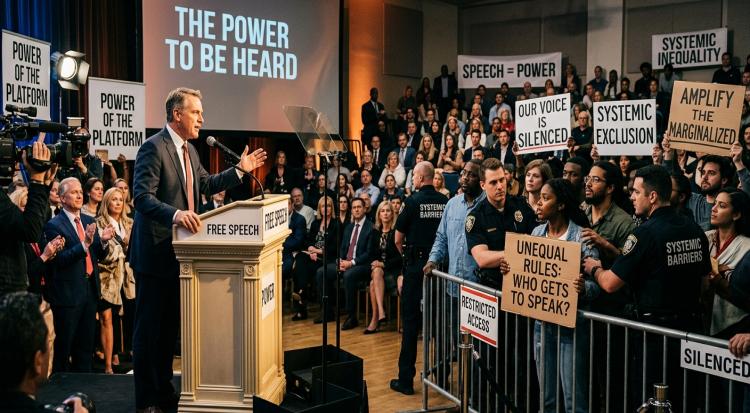
Across Britain and parts of Europe, “freedom of speech” is increasingly used in a selective way. The article argues that it is often invoked to defend far-right or Islamophobic rhetoric, while criticism of such speech is portrayed as an attempt to censor legitimate opinion.
Events like the “Unite the Kingdom” march are defended in the language of democratic expression and patriotic concern, even when they involve anti-immigrant or anti-Muslim messaging. At the same time, Muslim political expression—whether anti-racist activism, criticism of Islamophobia, or solidarity with Palestine—is more likely to be treated as controversial, disruptive, or even securitised. This creates an uneven standard in which some speech is protected as courageous truth-telling, while other speech is framed as dangerous or excessive.
The article traces this pattern to broader political and historical dynamics in Britain. Debates over defining Islamophobia, for instance, are often resisted on the grounds that they could restrict free speech, while offensive or racialised comments about Muslims are defended as legitimate commentary. Even political scrutiny of statements such as claims about Muslim prayer being “acts of domination” is quickly reframed as an attack on free expression rather than a discussion about racialised rhetoric.
Historically, similar arguments were used against race relations laws in the 1960s and 1970s. Measures intended to limit racial discrimination were criticised as threats to liberty and British values, showing a recurring tendency to frame anti-racist reform as authoritarian.
The article also highlights how accusations of racism are frequently deflected through appeals to humour and satire. From older examples like blackface entertainment to modern controversies over mocking Muslim identity or dress, racist portrayals are often dismissed as “just jokes,” while critics are portrayed as humourless or censorious.
Finally, it connects this to more recent restrictions on pro-Palestinian speech in universities and public life, described by some scholars as a “Palestine exception” to free expression. The overall argument is that free speech is not applied neutrally, but reflects underlying power structures—determining whose voices are protected, whose are restricted, and whose concerns are taken seriously.