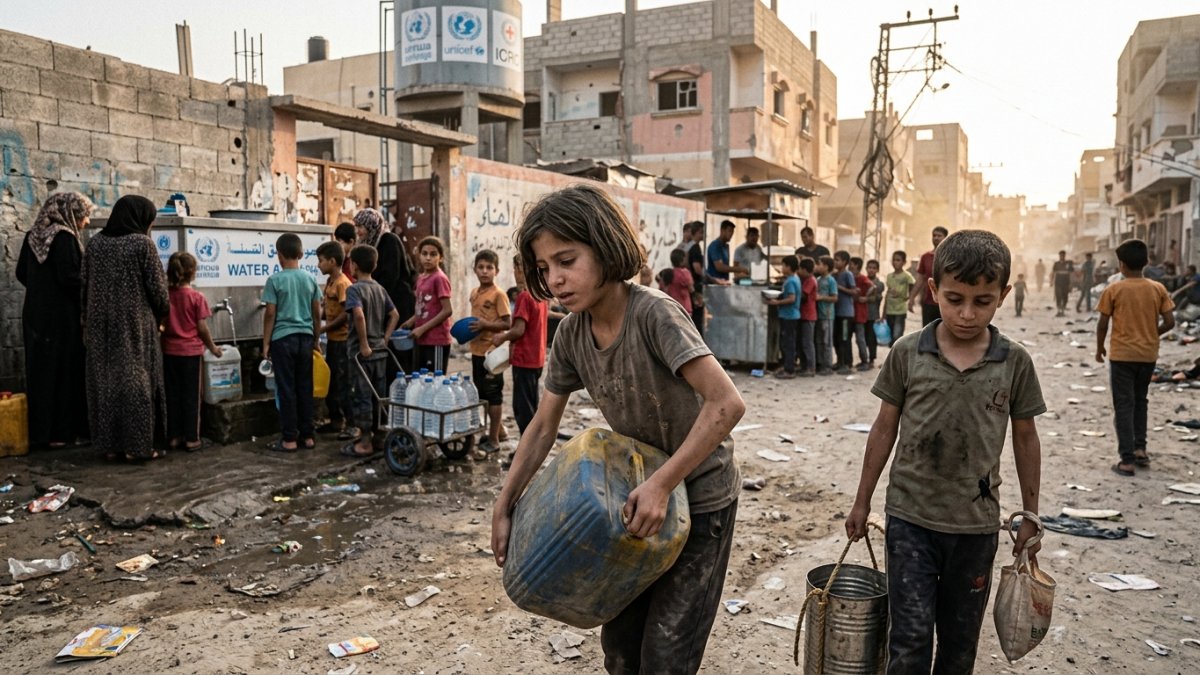
Daily Struggle for Water and Food Takes a Heavy Physical Toll on Gaza’s Children
In Gaza’s displacement camps, children are carrying responsibilities far beyond their years as families struggle to secure basic necessities such as clean water and food.
Ten-year-old Maysara Zaqout begins her day waiting for water trucks with her five-year-old brother, Jawad. When a truck finally arrives, she leaves her English class to fill containers. She recently carried about 20 litres of water back to her family’s tent, where six people depend on it for drinking, cooking, cleaning and sanitation.
For children like Maysara, Yamen Saleh, 12, and his six-year-old brother Aman, searching for water and food has become a daily routine. Yamen says carrying heavy containers leaves him with severe shoulder and back pain, and he sometimes falls because of the weight.
Their mother, Fidaa Saleh, says the constant search for food and water leaves her children exhausted, affecting their appetite, sleep, education and ability to play.
Doctors in central Gaza say the physical consequences are becoming increasingly serious. Dr Sumaya Salah reports seeing children suffering from muscle strain, spasms, hernias and spinal problems. She cited the case of nine-year-old Raghad, who developed scoliosis after repeatedly carrying water long distances during periods of famine.
According to Salah, such conditions were uncommon among children before the war began in October 2023, but medical clinics are now seeing multiple cases every day.
The crisis continues as most of Gaza’s population remains displaced and dependent on humanitarian assistance. Aid organisations have also reduced some services amid funding shortages and restrictions affecting the entry of humanitarian supplies.
For Gaza’s children, the struggle for water and food is therefore not only depriving them of basic necessities—it is also taking a lasting physical and emotional toll on a generation growing up amid prolonged displacement and destruction.