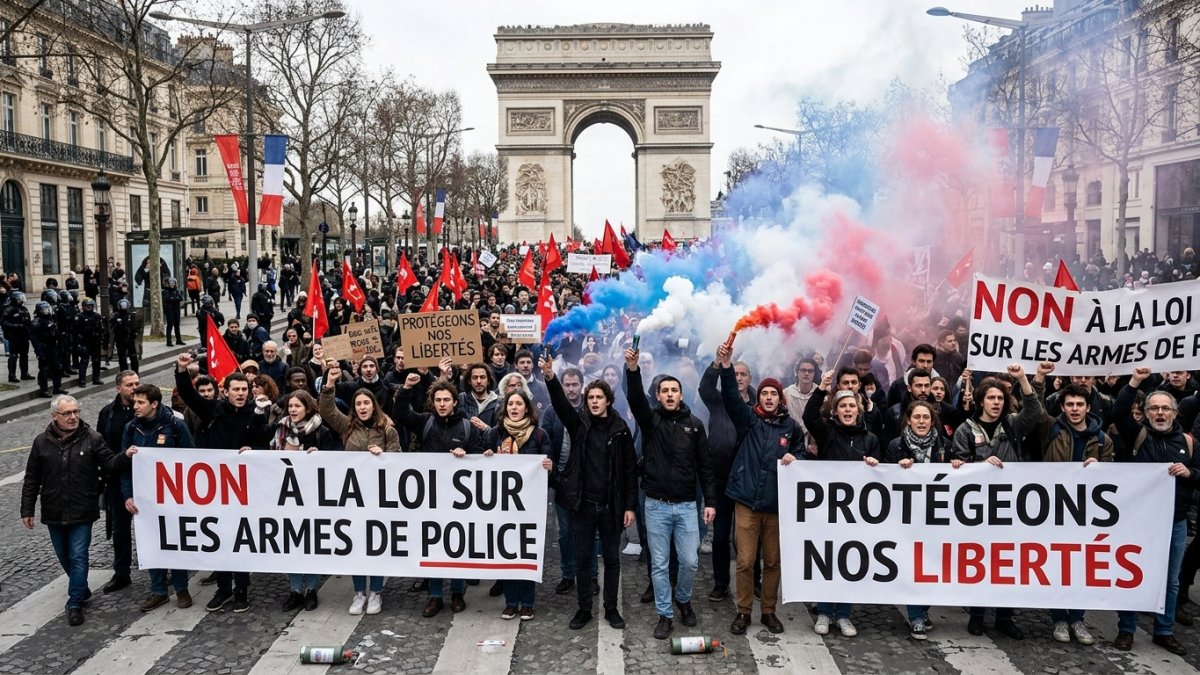
Thousands of people marched in Paris and other French cities on 20 September against a proposed police firearms bill. Police said around 8,200 people demonstrated in Lyon and Toulouse. Protests also took place in Marseille and Rennes; officials in Rennes reported eight arrests and three injured officers after projectiles were thrown.
Left-wing politicians, rights organisations including Amnesty International, France’s magistrates’ union and the League of Human Rights joined the demonstrations. Opponents have labelled the proposal a “licence to kill,” arguing it risks shielding officers from scrutiny when they use firearms.
What the bill would change
Draft Bill 691 would create a presumption of legitimate self-defence or lawful conduct for police officers and gendarmes who use firearms while carrying out their duties. In practice, a person bringing a complaint would have to show that an officer was not acting in self-defence. The presumption could be overturned if an investigation found the use of a weapon manifestly disproportionate or contrary to the legal requirement of absolute necessity.
France’s National Assembly approved the bill in July. The proposal is now due for a vote in the Senate, the upper house of parliament; it has not yet become law.
The measure was proposed by Eric Pauget of the right-wing Les Républicains party and has long been sought by the far-right National Rally. Supporters, including Interior Minister Laurent Nunez, say stronger legal protection is needed for officers working in dangerous situations, particularly against organised crime. Nunez has said prosecutors would still be able to overturn the presumption when circumstances warrant it.
Rights groups raise accountability concerns
Critics say the change could shift the burden of proof onto victims and their families, potentially slowing investigations into fatal police shootings. The United Nations has warned that the proposal could normalise violence against civilians and conflict with international principles that place strict limits on lethal force. Rights groups have also cautioned that the bill could increase fatal shootings and erode public confidence in law enforcement.
The debate comes amid longstanding allegations of police violence, particularly affecting Black and Arab communities in the banlieues, or outer suburbs, of Paris and other major cities. French oversight agencies recorded 69 people killed by police or gendarmerie officers in 2024, up from 49 in 2023 and 50 in 2022.
Past cases remain part of the debate. Nahel Merzouk, 17, was shot dead by police in Nanterre in June 2023, prompting nationwide protests. In March, an appeals court ruled the officer who shot him should stand trial for violence leading to the teenager’s death. Souheil El Khalfaoui, 19, was fatally shot during a traffic stop in Marseille in 2021; the investigation remains open. Adama Traoré, 24, died in custody after being restrained in 2016, and his death also sparked protests. France’s top court this year declined to reopen the investigation into Traoré’s death.
Source: Al Jazeera, 22 September 2026.