Egypt’s Energy Paradox: Importing LNG, Exporting Influence
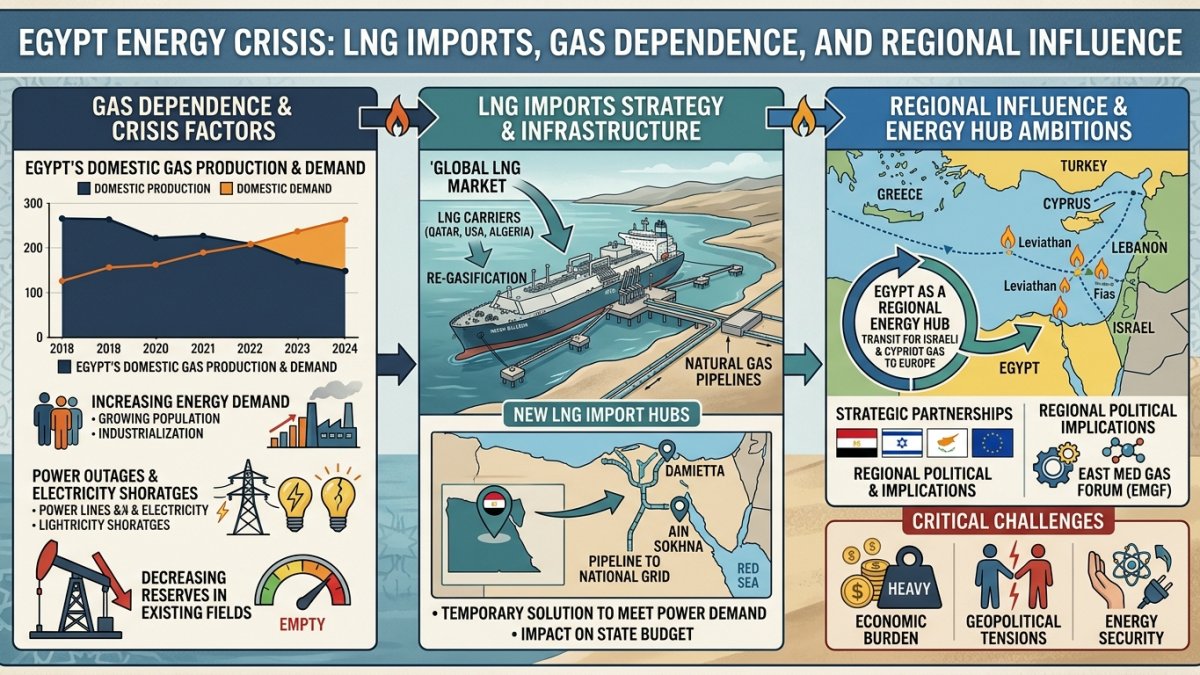
Egypt is facing a growing energy paradox. Once seen as a major gas hub in the Eastern Mediterranean, the country is increasingly importing liquefied natural gas (LNG) to meet domestic electricity and industrial demand. Yet, despite declining domestic production, Cairo continues to strengthen its regional influence through energy infrastructure, transit routes and strategic partnerships.
The shift reflects a broader change in Egypt’s energy strategy: from relying primarily on its own gas reserves to leveraging its geographic position and existing infrastructure.
From Gas Exporter to LNG Importer
The discovery of the Zohr gas field in 2015 raised hopes that Egypt could become self-sufficient and a major regional gas exporter. Production growth and the revival of the Idku and Damietta liquefaction terminals briefly positioned Egypt at the centre of Eastern Mediterranean energy plans.
However, falling production from mature fields, rising electricity consumption, population growth and limited upstream investment have weakened the country’s gas balance. Egypt is now expected to rely heavily on imported pipeline gas and LNG, with imports potentially reaching about 1.08 trillion cubic feet between July 2026 and June 2027.
Cairo is also pursuing long-term LNG contracts to reduce exposure to volatile spot prices. While these agreements could improve energy security, they also increase pressure on foreign-currency reserves, public finances and an already debt-burdened economy.
Infrastructure Gives Egypt Regional Influence
Declining gas production has not eliminated Egypt’s importance in the regional energy market. The country controls valuable infrastructure, including the Idku and Damietta LNG terminals, extensive pipelines, floating storage and regasification units, the Suez Canal and the SUMED pipeline.
These assets allow Egypt to act as an energy intermediary. Gas produced by neighbouring countries can enter Egypt, be processed or liquefied, and then reach international markets.
Its cooperation with Cyprus illustrates this model. Plans to transport gas from fields such as Cronos and Aphrodite to Egypt for processing and export could strengthen Cairo’s position as a gateway between Eastern Mediterranean producers and global consumers.
Egypt therefore increasingly derives energy influence not from the amount of gas it produces, but from its ability to connect producers, infrastructure and international markets.
Dependence on Israeli Gas Creates Vulnerability
This strategy also carries significant risks. Egypt has become partly dependent on Israeli gas supplies from fields including Tamar and Leviathan. Any disruption to those flows could affect electricity generation, industrial production and Egypt’s need for additional LNG imports.
The Gaza war and broader political tensions between Egypt and Israel make this dependence particularly sensitive. Infrastructure that gives Cairo regional leverage can simultaneously expose the country to geopolitical shocks beyond its control.
As Egypt expands its role as a processing and re-export centre, securing diverse and reliable sources of imported gas will become increasingly important.
The Domestic Economic Cost
Egypt’s growing LNG dependence is also creating domestic economic challenges. Imported LNG requires foreign currency and can raise the cost of electricity generation and industrial production, particularly when gas is sold domestically at subsidised prices.
To manage periods of high demand, Egypt has expanded its regasification capacity to four floating storage and regasification units, providing around 2.7 billion cubic feet per day. This capacity helps prevent energy shortages but also highlights the scale of the country’s dependence on imports.
For Egypt, the key challenge is ensuring that imported energy strengthens rather than undermines economic stability.
The country needs to revive domestic gas production, accelerate renewable-energy development to reduce reliance on gas-fired power generation and diversify external suppliers. Without these measures, energy diplomacy could increasingly become a way of managing scarcity rather than exercising strategic power.
From Gas Hub to Energy Broker
Egypt may not return to the era of abundant domestic gas that followed the discovery of Zohr. Instead, its future influence could depend on becoming an energy broker connecting producers, markets and transit routes.
If Cairo can combine reliable supply, diversified partnerships and effective use of its infrastructure, rising LNG imports do not necessarily have to signal a loss of regional influence. They could become part of a new energy model based on connectivity and interdependence.
Egypt’s energy paradox ultimately reflects a broader transformation in Middle Eastern power: countries do not necessarily need to produce the most resources to remain influential. Increasingly, control over the networks through which energy moves can be just as strategically valuable.