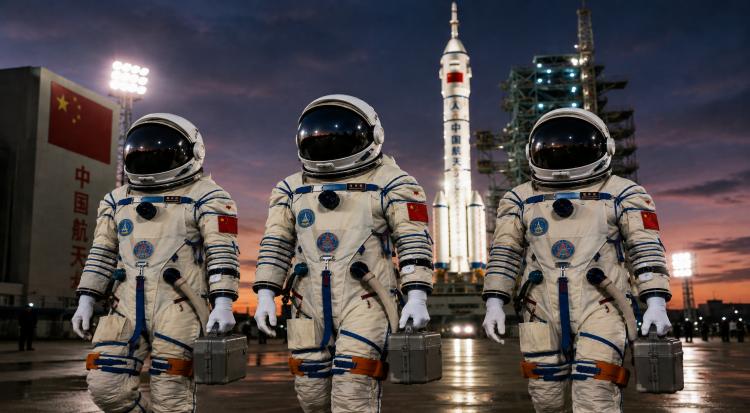
China launched three astronauts aboard the Shenzhou-23 mission on May 24 as Beijing continues advancing toward its goal of landing astronauts on the Moon before 2030.
The crew travelled to China’s Tiangong space station, where one astronaut is expected to remain in orbit for around a year as part of research into the long-term physical and psychological effects of extended space travel. The mission is intended to support future deep-space exploration, including planned lunar missions.
Chinese space authorities said the programme will help scientists better understand how astronauts adapt to prolonged periods in space. The mission also forms part of broader preparations for a crewed Moon landing, with testing continuing on new rockets, spacecraft and lunar landing systems.
China has rapidly expanded its space programme over the past decade, completing the Tiangong space station in 2022 and carrying out regular crewed missions since then. Beijing has repeatedly stated that becoming a major space power and achieving a successful crewed lunar landing remain key national objectives for the end of the decade.