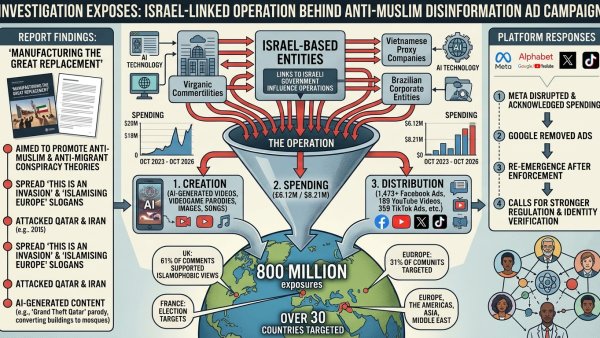
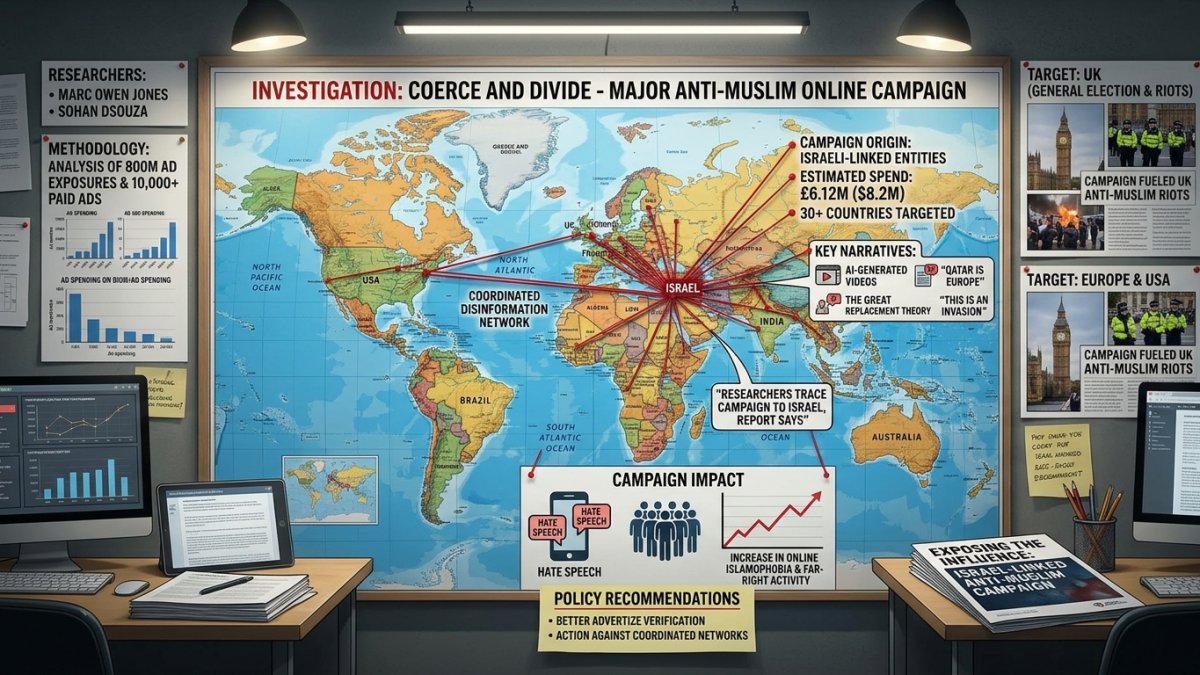
A multi-year investigation by researchers Marc Owen Jones and Sohan Dsouza says a large online advertising operation promoting anti-Muslim, anti-migrant and anti-Qatar messages can be traced with moderate to high confidence to operators in Israel. The researchers describe a network of paid advertisements and videos distributed across several countries, including the United Kingdom.
Their report estimates the campaign generated at least 533 million exposures between October 2023 and October 2026. It says the content framed Qatar as a force behind migration and an alleged effort to reshape Europe, using material that researchers characterized as racist and Islamophobic. The UK-focused advertising ran in the period before the 2024 general election was called and stopped on May 17 that year.
The attribution rests on a combination of clues, including digital metadata, account activity and links between campaign creators and Israeli political communications circles. The researchers say these indicators point to Israeli-based private actors. Their findings do not by themselves establish that the Israeli government commissioned, directed or funded the operation.
The campaign’s timing has prompted questions about attempts to influence public debate and electoral environments. However, the fact that advertising stopped before the 2024 Southport attacks and subsequent anti-Muslim riots does not prove the campaign caused or organized that violence. The investigation highlights the difficulty of identifying who pays for political messaging online and how platforms and election regulators can respond to covert influence activity.