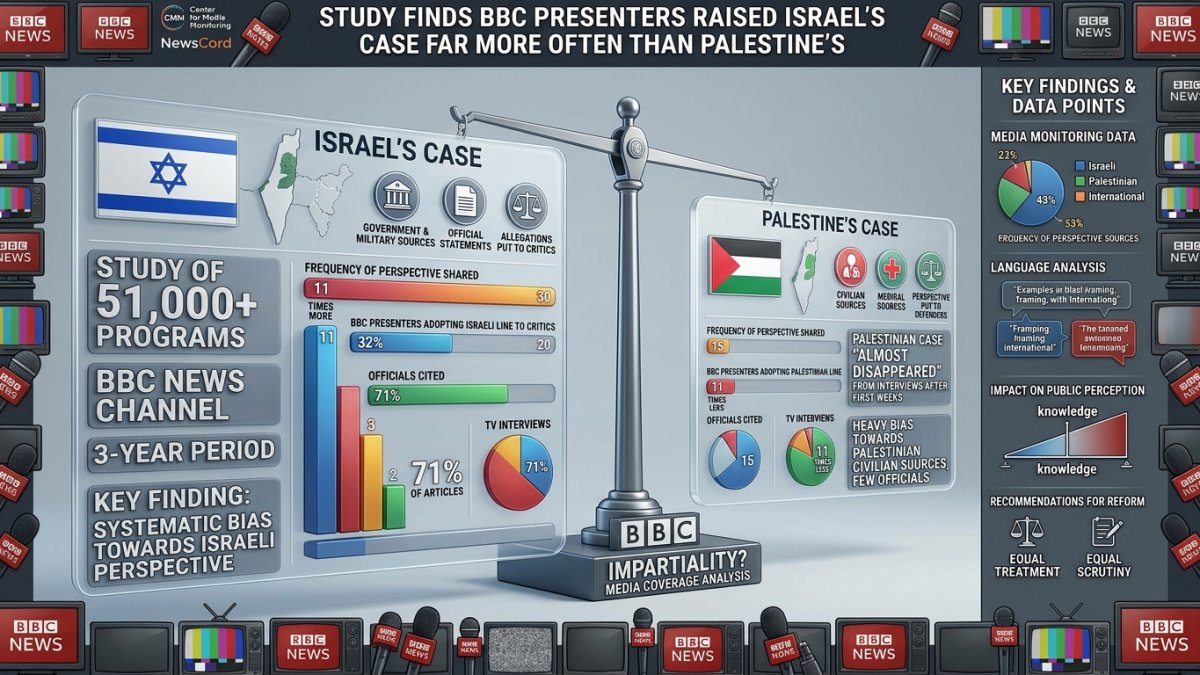
A media monitoring study has found that BBC News presenters raised Israel’s position far more often than the Palestinian position when interviewing guests who criticised or defended Israel’s conduct in Gaza. The analysis covers the period from October 2023 to October 2026 and examines both broadcast interviews and written articles.
Researchers searched subtitles from more than 51,000 BBC News Channel programmes, then manually checked the results to confirm that presenters were putting one side’s argument to a guest associated with the other. In the 267 interviews that met the study’s criteria, presenters put Israel’s case to critics of its conduct in 252 instances. They put the Palestinian case to guests defending Israel in 15.
The study also reviewed 1,618 written articles. It found that when BBC reports included criticism of Israel’s conduct in Gaza, Israel’s position appeared 49 per cent of the time. When articles reported Israeli claims, a Palestinian or United Nations position appeared in 38 per cent of cases, while a Palestinian position alone appeared in 25 per cent. The researchers reported similar differences when comparing claims made by Gaza authorities and by Israel’s government or military.
These figures reflect the study’s chosen search terms, sample and definitions; they are not a finding by the BBC or a formal ruling on individual reports. The BBC’s complaints unit has previously said that putting opposing views to interviewees does not mean the interviewer endorses those views. The study’s authors argue that the approach should be applied consistently, and say their results raise questions about how often Palestinian perspectives are represented in coverage.